Results Viewer


|
Results Viewer |
|
|
Standalone DesignBuilder Results Viewer The Results Viewer is a separate application which can be used to view EnergyPlus results stored in one or more .eso files. It can be downloaded from the main Downloads > Software area of the DesignBuilder website. When installed the application allows you to view any results contained within EnergyPlus .eso and .htm results files. There are 3 ways to open .eso results files:
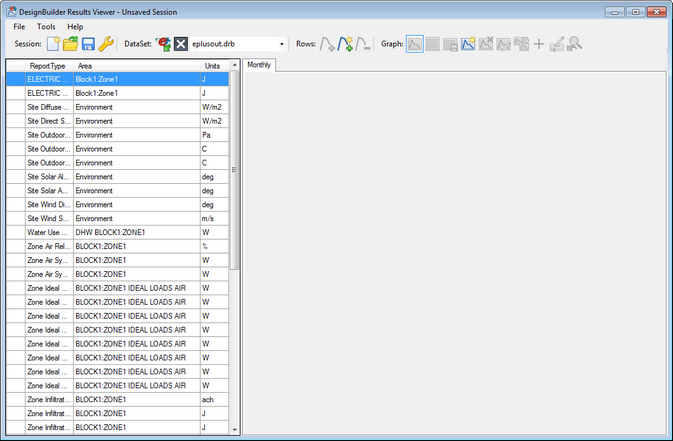
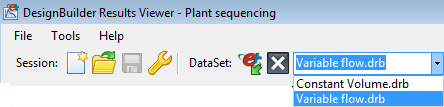
Multiple .eso and .htm files can be opened at a time. Use the combo box below the toolbar to select the current results set for plotting. With an .eso file open the first view will be something like that shown below.
DISPLAY RESULTS To show results for a particular interval use the Frequency drop list to select the interval. Sorting the Reports can be a useful way to help find particular data and can be achieved by clicking on the column headers. For example to see data sorted by "Area" click on the Area header. This will collect together all data for each zone, HVAC component, Environment etc. in the list. To plot a report on a graph use one of these methods:
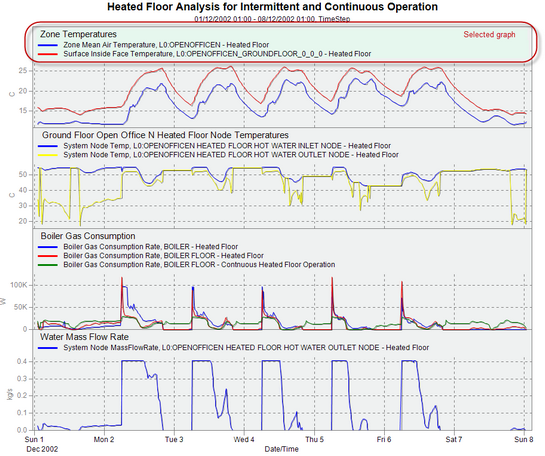
Selecting a graph If you have more than 1 graph set up you can select the current graph simply by clicking on it. You will see the graph heating highlight in a different blue when selected as shown below.
MENU COMMANDS You can access a range of options from the top bar menu, toolbar and right-click context menus. These are as follows: Display grid Display the data as a grid instead of a graph. Display graph Display the data as a graph instead of a grid. Save grid to CSV Allows you to save the data as a comma separated values file for loading into a spreadsheet for further analysis. Copy graphs to another frequency If you have generated similar data for multiple frequencies then use this tool to use settings for the current frequency and display the same reports using a different frequency. Change main title Change the text to be used for the main title for all graphs Rename graph title Allows you to change the title for the currently selected graph. To change the name of the current graph right-click on the graph and from the DesignBuilder Options, select the Rename graph title option. Enter the title for the graph in the dialog and press OK. Remove selected graph Deletes the current graph. Any data displayed in the graph is unaffected. Cross hair on/off Checking this option displayed a cross hair which allows you to create a vertical and horizontal line when you click on a data point. It can be useful to check simultaneous values for a range of reports. Template Load/Save When you create graphs with Results Viewer, they are styled (e.g. Title Font, Background colour, etc) using a default styling template. You can change the styling defaults to your own preferences by using the right-hand context menu on the graph pane. The following options are currently available:
If you make some changes and want to revert back to the default styling at any time, select the Tools > Restore Graph Styling menu option. Any styling changes made to the currently open session will be made permanent once the session has been saved. If you wish to reuse your styling changes, you can save these to a styling template file and apply them to other sessions. Use the Tools> Template > Save option to save your styling template as a standalone file, ie outside of the session (note: the '.drt' file extension is used for styling template files). The Tools > Template > Load option can then be used to apply this style to another session. LOADING MULTIPLE DATA SETS You can load as many data sets as required to a single Results Viewer session by using the Open eso/Dataset menu or toolbar option. A list is maintained of all data sets currently opened in the drop list at the top of the window.
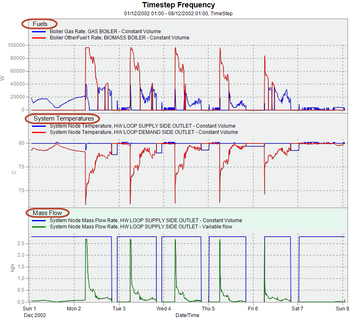
When you have more than one data set open it usually helps to Include the dataset name in the legend. This can be done from the Options dialog. OPTIONS DIALOG The Options dialog is accessed either from the toolbar Autosave session Select this option if you would like the session to be saved automatically when closing the Results Viewer. Display a title for each graph Selecting this option causes the title of each graph to be displayed for each graph as shown in highlighted areas in the graph below.
To change the name of the current graph right-click on the graph and from the DesignBuilder Options, select the Rename graph title option. Enter the title for the graph in the dialog and press OK. Include dataset name in legend If you have more than one data set loaded then you should usually select this option to ensure that the data set name is included in the legend. This can help when comparing results for different simulations.
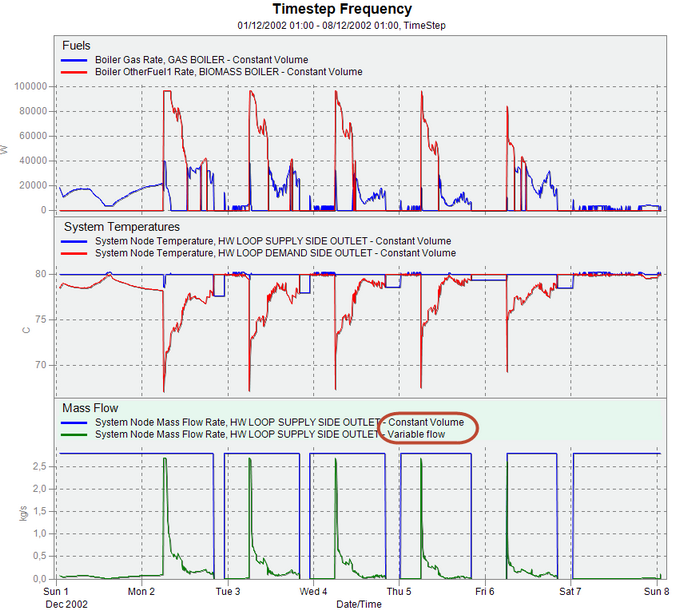
The output above shows how the dataset name is added to each legend. Include folder name in dataset name If you include the dataset name in the legend then do you want the folder name included too? If so check this option. This option is only usually used when the result sets are stored in files with the same name but in different folders. ZOOMING In some cases you may find that too much data is displayed on the X-axis at one time and you need to focus on a section (time period) of the results graph. You can use the mouse to do this simply by dragging a time region of interest. This allows you to zoom in on data for particular days. To return back to the original "un-zoomed" state, use the Undo zoom toolbar option. SESSIONS It can take some time to load.eso files and to select results so DesignBuilder provides methods to save pre-processed results files and session files to speed loading and setting up reports the next time. .drb results files When the Results Viewer loads an .eso file it automatically generates a .drb file with exactly the same data but in a form that can be loaded much more quickly. If you need to view the results again in future you can open the drb file instead of the .eso file. The .drb file will have the same filename as the original .eso file (apart from the extension). It does not contain any display settings - just the data. .drs results files You can also save a session file which stores all of your display settings for a graphing session as well as the corresponding .drb file(s). Opening the session file will take you back to where you were before saving the session file. Session files provide a very useful way to package up all data and settings for a Results Viewer session in a small file size. They can be sent to colleagues for viewing. You can configure DesignBuilder to save.eso files in various ways as described for the EnergyPlus tab of the Program options. If you plan to use the Results Viewer in favour of the inbuilt DesignBuilder results display then you might use one of the settings configurations below:
Nostale Fish Bot Work — !!hot!!Yes, technically. Private, paid scripts using advanced image recognition (OpenCV) and randomized human-emulated inputs do work. They can run for weeks undetected. Simpler scripts monitor specific screen coordinates for color changes (e.g., the bobber moving or a mini-game indicator appearing) and trigger a keyboard input (like the 'E' key or a skill bar slot). Packet Logging: Some advanced tools use specialized APIs (e.g., PacketLogger_API.au3 have not been updated in years, making them easily detectable by modern anti-cheat systems. How the Angler SP Works (Legitimately) Instead of risking your account, you can master the Angler Specialist Core Skills : You must use skills like Special Abilities : Higher-level anglers can use Teleport to Fishing Spot for fast travel or Covert Fishing to stay undetected by monsters while they fish. Progressing : The quest involves visiting NPCs like Propka in Desert Harbor and fetching materials like rotten eggs for the story line. fastest way to level the Angler Specialist Card without using external scripts? Nostale Let's Play Part 49 - Starting Fishing SP : Features often include stopping once the inventory is full or using specific items to clear space. nostale fish bot work The Fish Bot uses a combination of algorithms and game API (Application Programming Interface) interactions to simulate fishing actions within the game. Here's a simplified overview of its functionality: Third, the bot executes the “reeling in” command. It simulates pressing the required key (often the spacebar or a designated number key) at the precise moment of the bite. After a short delay for the catching animation, the bot returns to step one: casting the line again. To avoid detection, more sophisticated bots include random delays between actions, mimicking human reaction times and preventing a suspiciously consistent pattern that server-side anti-cheat systems can detect. The world of NosTale , the popular anime-style MMORPG, is vast and filled with opportunities for adventure and progression. Among the many activities players can engage in, fishing stands out as a relaxing yet potentially lucrative profession. However, the repetitive nature of casting a line and waiting for a bite has led many players to seek automated solutions: the "fish bot." This article provides a thorough, research-driven examination of what is, the various types of bots available, how they function, the significant risks involved, and the legitimate alternatives for advancing your Angler specialist. Yes, technically Nostale uses , a kernel-level anti-cheat system. It scans for: user wants a long article about "nostale fish bot work". This likely refers to fishing bots in the game Nostale. I need to cover how they work, legality, risks, and alternatives. I'll search for relevant information. search results show several potential sources. I need to open them to gather detailed information. I will open the GitHub repository for FishBot-v2, the Keyran macro pages, the BotMek pages, the GitHub repository for the pond minigame bot, the forum rules and ban risk pages, and the game rules page. This should provide enough technical detail, usage instructions, and risk information. opened pages provide a wealth of information. I now have a good understanding of the topic. I need to structure the article. I'll cover: what Nostale fish bots are, their types (DLL injection, memory-based, image recognition, macros), how they work, how to use them, the risks (permanent bans, account theft, malware), and legitimate alternatives. I'll also include a disclaimer. I will search for additional information on bot statistics, player surveys, and Gameforge's anti-cheat measures. search results provide a good amount of information. I will structure the article with an introduction, an explanation of what fish bots are, a section on how they work, a guide on how to use them, a section on risks and consequences, a section on legitimate alternatives, a disclaimer, and a conclusion. I will cite the relevant sources. Now I will write the article. Nostale Fish Bot Work: A Comprehensive Guide Upgrade your fishing rod to increase your chances of catching higher-tier fish. Progressing : The quest involves visiting NPCs like The mechanics of a revolve around automating the reaction-based minigame introduced with the fishing system. These bots typically work by "reading" the game screen to identify specific visual triggers, such as the movement of the fishing bar or the appearance of the exclamation mark above the character's head. How a NosTale Fish Bot Functions : Many simpler bots are written in AutoIt or C++ , as seen in public repositories like FishBot-v2 .
|
 or from the Tools top menu option.